When, Why and How to Prune Apple Trees in UK Gardens
Apple tree pruning is one of the most misunderstood jobs in the garden. Many gardeners know it is important, but hesitate when it comes time to pick up the secateurs. The fear of cutting the wrong branch, damaging the tree, or ruining next year’s crop often leads to apple trees being left untouched year after year.
Part of the confusion comes from mixed advice. Some guides are overly technical, others contradict each other, and many assume a level of experience most home gardeners simply do not have. The result is uncertainty, hesitation, and apple trees that slowly become overcrowded, unproductive, and harder to manage.
The biggest myth about pruning apple trees is that it is easy to get it wrong. In reality, apple trees are resilient. Sensible pruning improves their health far more often than it harms them. Leaving an apple tree unpruned for years is usually far more damaging than making a few imperfect cuts.
This guide is designed to remove that fear. You will learn why apple trees need pruning, when to prune them in the UK, what branches to remove first, and how to prune with confidence rather than guesswork. Whether your apple tree is young, mature, or long neglected, this guide will help you understand what the tree needs and how to give it the best chance to thrive.
Contents
Why Apple Trees Need Pruning
Pruning is not about controlling an apple tree, it is about working with how the tree naturally grows. Left alone, apple trees will continue to produce branches year after year, but not all growth is useful or healthy.
One of the main reasons apple trees need pruning is light. Apples form and ripen best when sunlight can reach the flowering and fruiting wood. As a tree becomes crowded, the centre fills with shaded branches. These shaded areas produce fewer flowers, weaker growth, and poor-quality fruit.
Airflow is just as important. Dense, congested branches trap moisture, especially in the UK’s damp climate. This creates ideal conditions for fungal diseases such as apple scab and canker. Pruning opens the canopy, allowing air to move freely and helping leaves and fruit dry more quickly after rain.
Pruning also helps the tree use its energy effectively. An unpruned apple tree often puts energy into long, upright shoots that do little for fruit production. By removing excess growth, the tree is encouraged to direct its energy into fruiting spurs, stronger branches, and better-quality apples.
Structure is another key reason for pruning. Well-pruned apple trees develop strong, well-spaced branches that can support the weight of fruit without snapping. Poor structure leads to weak junctions, crossing branches, and breakages as the tree matures.
Finally, pruning plays a long-term role in the health and lifespan of the tree. Regular, sensible pruning keeps apple trees productive for decades. Without it, trees often become too large to manage, more prone to disease, and increasingly difficult to restore.
Pruning is not about perfection. It is about improving light, airflow, structure, and balance year after year.
When to Prune Apple Trees in the UK
Knowing when to prune an apple tree is just as important as knowing what to cut. In the UK, apple trees are pruned at different times of year for different reasons, and understanding this makes pruning far less confusing.
Winter pruning is the main pruning period for apple trees. It is usually carried out between late November and early March, once the tree is fully dormant and before new growth begins. During dormancy, the structure of the tree is easy to see, making it simpler to decide which branches to remove. Winter pruning encourages strong new growth in spring and is ideal for shaping young trees, improving structure, and reducing overcrowding.
Late winter is generally preferred to early winter. Pruning too early can leave fresh cuts exposed to prolonged cold and wet conditions, increasing the risk of disease. It is also best to avoid pruning during hard frosts, as frozen wood can split and damage more easily.
Summer pruning serves a different purpose. It is typically carried out between July and early September and focuses on controlling excessive growth rather than shaping the tree. Summer pruning slows vigorous shoots, improves light penetration to ripening fruit, and helps maintain trained forms such as espaliers and cordons. It is lighter and more selective than winter pruning.
There are also times when apple trees should not be pruned. Pruning during late spring can remove developing flowers and fruit, reducing the crop for that year. Pruning during very wet weather increases the risk of disease entering through fresh cuts. As a rule, pruning is best avoided when conditions are cold, wet, or frosty.
The age of the tree also matters. Young apple trees benefit most from winter pruning to establish a strong framework. Mature, established trees may only need light winter pruning combined with occasional summer pruning to control growth and maintain shape.
Understanding the difference between winter and summer pruning removes much of the uncertainty. Once the timing is right, the actual pruning decisions become far easier to make.
Understanding Apple Tree Shapes
Before making any cuts, it is important to understand the shape your apple tree has been trained into. Apple trees are not all pruned the same way. Their shape determines how they grow, where they fruit, and how they should be managed long term.
The most common shape in UK gardens is the bush apple tree. These have a short trunk and an open, rounded canopy. Bush trees are designed to let light into the centre while keeping the tree at a manageable height. Pruning focuses on maintaining an open structure, removing overcrowded branches, and encouraging outward-facing growth.
Espalier apple trees are trained flat against a wall or fence in horizontal tiers. This shape is popular in smaller gardens and productive spaces. Pruning espaliers is about maintaining clear horizontal arms and controlling vertical growth. Summer pruning is especially important for this form, as it keeps the tree flat and allows sunlight to reach developing fruit.
Cordons are narrow, upright trees trained along wires or posts. They are often grown at an angle and take up very little space. Pruning cordons is light but regular, with an emphasis on controlling side shoots and encouraging fruiting spurs close to the main stem.
Standard and half-standard apple trees are larger trees with a longer trunk and broader canopy. These are often found in older gardens or orchards. Pruning focuses on safety, structure, and long-term health rather than keeping the tree compact. Because of their size, pruning is usually lighter and spread over several seasons.
Understanding your tree’s shape prevents over-pruning and frustration. A cut that makes sense on a bush tree may be completely wrong for an espalier or cordon. Once you know the shape, pruning becomes about maintenance rather than guesswork.
If you are unsure of your apple tree’s shape, observe how it has been trained rather than how it looks today. The original form always matters more than temporary growth.
Tools You Need for Apple Tree Pruning
You do not need a large collection of tools to prune apple trees properly. A few good-quality, well-maintained tools will do a far better job than a shed full of blunt ones.
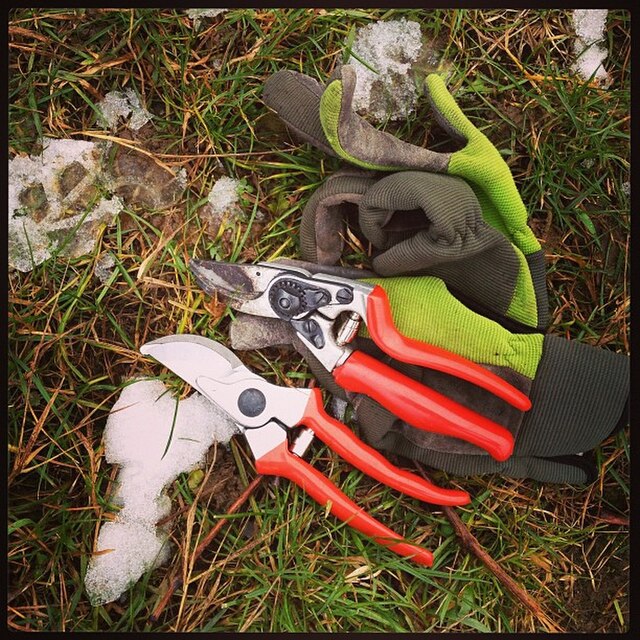
Secateurs are the most important tool. They are used for the majority of cuts on apple trees, especially younger growth and fruiting wood. Clean, sharp secateurs make precise cuts that heal quickly and reduce the risk of disease.
Loppers are useful for thicker branches that are too large for secateurs but not large enough to require a saw. Long-handled loppers give better leverage and allow you to make controlled cuts without tearing the wood.
A pruning saw is needed for older, thicker branches. These produce a clean cut with minimal effort and are safer and more effective than forcing a cut with loppers.
Tool hygiene is often overlooked but is important, particularly when pruning multiple trees. Wiping blades between trees and after removing diseased wood helps prevent the spread of fungal and bacterial problems.
Sharp tools matter. Blunt blades crush rather than cut, leaving rough wounds that take longer to heal and are more vulnerable to infection. Regular cleaning and sharpening are part of good pruning practice.
For most home gardeners, these three tools are all that is needed. Technique and understanding matter far more than expensive equipment.
Step by Step Pruning Apple Trees
When you stand in front of an apple tree, secateurs in hand, eager as can be. It can be difficult to know where to start…
The simplest way to approach pruning is to remove the obvious problem growth first. These initial cuts instantly improve the tree, making the remaining decisions much easier.
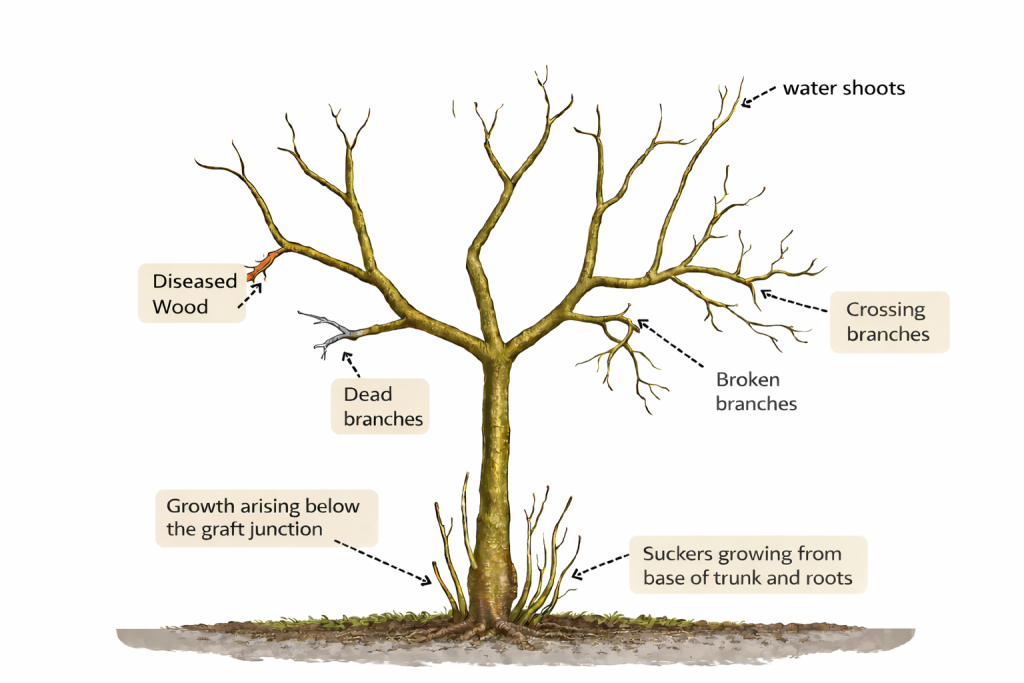
Start by removing dead wood. Dead branches are usually brittle, darker in colour, and show no signs of buds. They serve no purpose and can harbour disease, so they should always be removed completely.
Next, remove any diseased wood. This may show signs of canker, dieback, or damaged bark. Cuts should be made back to healthy wood, and tools should be cleaned afterwards to prevent the spread of infection.
Crossing branches is another priority. When branches rub against each other, they create wounds that allow disease to enter. Choose the stronger, better-placed branch and remove the other.
Branches growing inwards towards the centre of the tree should also be removed. These restrict light and airflow and contribute to congestion. Apple trees perform best with an open structure that allows sunlight to reach the middle of the canopy.
Then, look for vertical water shoots. These are fast-growing, upright shoots that appear after heavy pruning or strong growth. They rarely produce fruit and divert energy away from productive wood. Most should be removed completely, especially during winter pruning.
Growth that appears below the graft union and suckers rising from the base or roots should always be removed. This growth comes from the rootstock rather than the apple variety you want, and if left, it will compete for energy, weaken the tree, and can eventually dominate the canopy if not controlled.
By dealing with these types of growth, the tree quickly becomes clearer to read. Pruning then becomes a process of refinement rather than confusion.
How Much Can You Safely Prune an Apple Tree
One of the most common worries when pruning apple trees is cutting too much. Many gardeners stop too early because they are afraid of damaging the tree, while others remove too much in one go. Understanding how much to prune makes a huge difference.
A simple guideline is the one-third rule. In a single season, you should not remove more than roughly one third of the tree’s canopy. This allows the tree to respond without becoming stressed or producing excessive new growth.
Removing too much at once often leads to a flush of vertical water shoots the following spring. These shoots grow quickly but contribute little to fruiting and can undo much of the good work done during pruning. Heavy pruning can also temporarily reduce fruit production.
If an apple tree has been neglected for several years, it is tempting to cut it back hard in one session. This usually causes more harm than good. Restoring an overgrown apple tree is best done gradually over two or three seasons, improving structure a little each year.
Apple trees are resilient, and small mistakes are rarely disastrous. Even if you feel you have removed slightly more than intended, the tree will usually recover. Problems are more likely when pruning is severe and repeated in a short period of time.
The aim is balance. Pruning should improve light, airflow, and structure without shocking the tree. When in doubt, it is always better to remove a little less and reassess next season than to remove too much at once.
Pruning Young Apple Trees
Pruning young apple trees is less about cutting and more about guiding growth. The decisions made in the first few years shape the tree for the rest of its life, so restraint and patience are key.
In the first year after planting, pruning should be minimal. The main aim is to help the tree establish strong roots. Any broken, damaged, or badly placed shoots can be removed, but heavy pruning at this stage can slow establishment.
As the tree begins to grow, the focus shifts to creating a strong framework. This means selecting a small number of well-spaced branches that radiate outwards and form the main structure of the tree. These framework branches should have wide, strong angles where they join the trunk, as narrow angles are more likely to split under the weight of fruit later on.
Pruning young trees is often described as training rather than pruning. Cuts are used to encourage outward-facing growth, maintain balance, and prevent overcrowding before it becomes a problem. Regular light pruning is far more effective than heavy corrective pruning later.
It is also important to avoid letting young trees fruit too heavily too soon. Allowing excessive fruiting early on can weaken growth and affect long-term structure. Removing some early fruit can feel counterintuitive, but it helps the tree develop into a stronger, more productive plant in the future.
A well-pruned young apple tree may not look dramatic, but it will repay patience with easier maintenance, better structure, and consistent fruiting in the years ahead.
Pruning Mature and Neglected Apple Trees
Mature and neglected apple trees often look intimidating, but they can usually be improved with patient, sensible pruning. The key is to think in terms of restoration rather than instant results.
Older trees that have not been pruned for several years tend to have dense canopies, lots of crossing branches, and an abundance of upright water shoots. Heavy pruning in a single season may seem tempting, but it often causes stress, excessive regrowth, and reduced fruiting.
Restoration is best carried out gradually over two or three years. In the first year, focus on removing dead, diseased, and badly placed branches. Improving light and airflow should be the main aim rather than reshaping the entire tree at once.
Large, old branches should only be removed when absolutely necessary. Each large cut creates a wound that takes time to heal and can become an entry point for disease. Where possible, prioritise thinning rather than shortening heavy limbs.
As the tree responds to pruning, new growth will appear. Some of this growth can be useful and should be selected to replace poorly placed older branches. Other growth, particularly strong vertical shoots, can be removed gradually as part of ongoing maintenance.
It is important to accept that older trees will never look perfect. The goal is improved health, safer structure, and better fruiting, not cosmetic perfection. With steady pruning over time, even very neglected apple trees can become productive and manageable again.
Common Apple Tree Pruning Mistakes
Apple tree pruning mistakes are extremely common, especially among gardeners who are still building confidence. Most errors come from misunderstanding rather than carelessness, and they are usually easy to avoid once recognised.
One of the most frequent mistakes is pruning too much in one season. Removing large amounts of growth can shock the tree, reduce fruiting, and trigger excessive water shoot growth the following year. Steady, gradual pruning is far more effective.
Another common error is pruning at the wrong time. Cutting during late spring can remove flowers and developing fruit, while pruning in very wet or frosty conditions increases the risk of disease and damage.
Many gardeners also leave stubs when removing branches. These do not heal properly and can become entry points for rot and infection. Cuts should be made cleanly back to a healthy junction or bud.
Ignoring the natural shape of the tree is another mistake. Each apple tree has a form it has been trained to follow, and working against this often leads to frustration and unnecessary cutting.
Finally, chasing a perfect-looking tree can cause problems. Apple trees do not need to look symmetrical or tidy to be productive. Over-pruning in pursuit of perfection often does more harm than good.
Mistakes are part of learning. Apple trees are forgiving, and thoughtful pruning over time matters far more than getting everything right in a single season.
Aftercare Following Apple Tree Pruning
Once pruning is complete, very little aftercare is normally required. Correctly made cuts should be left open to dry naturally rather than covered with wound paint or sealant, which can trap moisture and interfere with the tree’s natural healing process.
Feeding is not automatically necessary after winter pruning. Unless growth has been weak or a deficiency is suspected, improving the soil around the tree is usually more valuable than applying a strong fertiliser. A spring mulch can conserve moisture, suppress weeds and help with improving soil structure.
Spread a layer of homemade compost or well-rotted leafmould across the root zone, keeping it approximately 10 cm away from the trunk to reduce the risk of rot. Mulching over the wider rooting area is far more useful than piling material directly around the base.
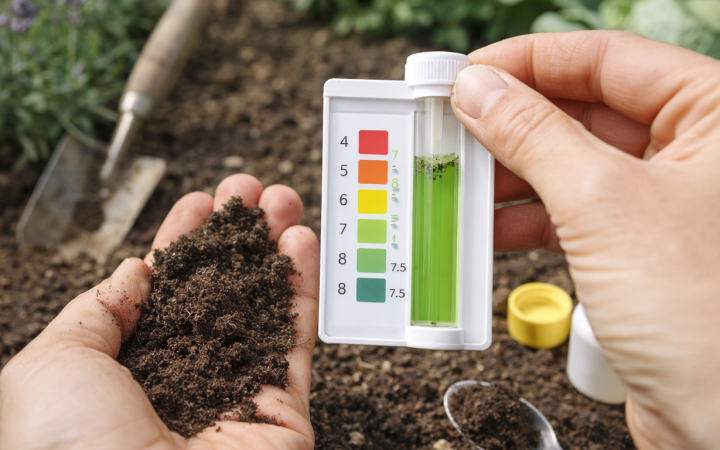
If the tree continues to grow poorly despite suitable care, consider checking the soil pH before adding fertiliser or attempting to alter the soil. Apple trees generally perform best in reasonably fertile, well-drained soil that is slightly acidic to neutral.
Observe the tree throughout the following growing season. Look at where vigorous shoots appear, whether the canopy remains balanced and how much fruiting growth develops. This response will help guide next winter’s pruning.
Good aftercare is largely about restraint. A healthy apple tree should recover well when pruning is measured, cuts are clean and the surrounding soil is properly cared for.
Final Thoughts
Pruning apple trees is not about forcing them into shape or achieving a perfect appearance. It is about understanding how the tree grows and making small, thoughtful decisions that improve its health over time.
No two apple trees are the same, and pruning will never be identical from one year to the next. What matters most is improving light, airflow, and structure while allowing the tree to respond naturally. Small imperfections in pruning rarely cause harm, but long-term neglect often does.
With regular, sensible pruning, apple trees become easier to manage, more productive, and healthier year after year. Confidence comes from observation as much as action, and each season provides a better understanding of how your tree responds.
Prune with purpose, stay patient, and let the tree guide you as much as you guide it.
GHUK content is written for UK growing conditions and informed by hands-on professional gardening experience. It is designed to be practical, clear and useful in real gardens.