A wisteria can cover a wall with flowers, or race across the guttering without producing much of a display. The difference starts with a suitable plant and position, then a framework you can reach and maintain.
For established wisteria, the usual UK routine is to shorten unwanted leafy side shoots to five or six leaves in July or August, then shorten those same shoots to two or three buds in January or February. Keep the main branches and any shoots needed to extend them.[1]
Start with the section that matches your plant. A new wisteria needs space to build its framework; an established one needs that framework kept clear. Neither benefits from cutting every stem to the same length.
Wisteria care at a glance
| Job | What to do |
|---|---|
| Position | A sunny, sheltered wall or strong garden structure, with soil that drains well. |
| Buying | Choose a named cultivar, ideally already flowering, rather than an unproven seedling. |
| Training | Keep permanent branches well spaced and check supports and ties regularly. |
| Summer pruning | July or August: reduce unwanted new side shoots to five or six leaves. |
| Winter pruning | January or February: shorten the summer-pruned shoots to two or three buds. |
| Poor flowering | Check age, shade, pruning, summer drought and spring frost before adding feed. |
Treat the pruning months as a routine to plan around, with the plant’s growth and local conditions in mind. If you are reading this in autumn, check the supports and plan the winter job rather than repeating the summer prune now.
Choose the right wisteria for your space
Chinese and Japanese wisterias are substantial, long lived climbers. Choose for the space the mature plant can occupy, including access for pruning, rather than the size of the nursery pot. A narrow arch or lightweight fence is a poor starting point for a vigorous specimen.
| Type | Display and position |
|---|---|
| Wisteria sinensis, Chinese wisteria | Spring flowers usually appear before the leaves. Suits a sunny wall or substantial pergola. |
| Wisteria floribunda, Japanese wisteria | Often has longer flower clusters, with leaves developing around flowering time. Allow the blooms to hang freely over a suitable structure. |
| Wisteria brachybotrys, silky wisteria | Shorter clusters with relatively large, often scented flowers. Check the cultivar’s size when choosing its wall or garden structure. |
| Wisteria frutescens ‘Amethyst Falls’ | A relatively compact American cultivar with short summer flower clusters. Consider for smaller spaces or a large container, with continuing pruning. |
These are useful tendencies, not guarantees for every cultivar. ‘Amethyst Falls’ can still reach several metres, so “compact” does not mean it can be left on a small cane indefinitely.[2][3]
For a named plant with a proven flowering history, look at cultivars such as Chinese ‘Prolific’ or ‘Amethyst’. Check flower colour, fragrance and eventual size before buying. If you inherit an unnamed plant, keep its label if you find one; twining direction alone is not a complete identification.[4]
Buying a wisteria that will flower
Ask how the plant was propagated. Wisterias raised from seed can take many years to flower and are an uncertain choice when the display is your main reason for planting. Named cultivars propagated by grafting or cuttings are the more dependable starting point. Buying in flower lets you see what you are getting.[5]
On a grafted plant, look for the union near the base and check it for damage. Also inspect the stems, roots and ties. A plant that has already flowered may still take time to settle after planting, so a quiet first season is not automatically a problem.
Where and how to plant wisteria
Choose a sunny position with room for the roots and a support strong enough for the mature climber. South and west facing walls are often useful. In colder or exposed gardens, shelter matters too: a hardy plant can still lose its developing flowers to frost.[5]
Install the support before planting. Against a wall, position the rootball roughly 45cm out from the base, beyond the driest strip of soil, and lead the stems towards the support. Check drainage first. Our guide to soil texture explains why different soils handle water differently.
- Water the rootball before planting and prepare a hole wider than the pot.
- Set the plant at its original nursery depth. Do not bury the stem deeply to make an overgrown plant look shorter.
- Backfill, firm gently and water thoroughly to settle soil around the roots.
- Mulch the surrounding soil, leaving a gap around the stem, and check moisture regularly during establishment.
Spring and autumn are convenient planting seasons. Wait if the ground is frozen or saturated; a calendar date is not a reason to force the job.[6]
Train the framework before chasing flowers
Wisteria twines around supports rather than sticking to a bare wall. The woody stems become heavy and thicker with age, so the framework needs permanent support, not just the cane supplied with the plant.
On a wall, train a main stem upwards and position selected side branches along horizontal supports. Space them so you can see and reach each branch. Keep growing tips that will fill an intended gap; once tied in, they become part of the framework rather than shoots to shorten routinely.
Use suitable soft ties with room for stems to expand. A figure of eight tie separates a heavy stem from its support and helps reduce rubbing. Check for tight ties, damaged fixings and stems becoming trapped behind wires. Avoid thin wire wrapped directly around the bark.[7]
Keep growth away from gutters, downpipes, roof tiles and opening windows. Plan access while the plant is young. If safe access or the condition of the structure is doubtful, arrange suitable help before the climber becomes larger.
How to prune wisteria in summer and winter
First identify the main framework, the side shoots growing from it, and any new stems you intend to keep. Routine pruning shortens side shoots; it does not mean cutting back every branch.
July or August: shorten the leafy side shoots
- Trace a long, whippy shoot back to the older branch it grows from.
- Keep it if you need it to extend or replace part of the framework.
- Otherwise, count five or six leaves out from its base and cut just above the last one you are keeping.
- Tie in retained shoots and check for growth heading into gutters or other unsuitable places.
Wisteria has compound leaves. Count whole leaves attached along the shoot, not the small individual leaflets within each leaf. The aim is a manageable plant with light reaching the short shoots that remain.[8]
January or February: shorten the same shoots again
- With the plant leafless, find the side shoots shortened in summer.
- Follow each back to the older framework and retain two or three buds near its base.
- Cut just above the last retained bud. Keep the permanent branch intact.
- Remove clearly dead or unwanted growth and check ties before spring growth starts.
A bud count is more useful than cutting everything to an identical length. If you are unsure which wood to keep, trace one branch at a time rather than cutting into the middle of a tangle.[1]
What if a pruning session was missed?
Missing one session does not mean starting again. At the next suitable pruning time, identify the structure first and work through the side growth. A heavily overgrown plant needs a renovation plan rather than increasingly severe cuts made in a hurry.
Why is my wisteria not flowering?
A leafy plant with few flowers needs a diagnosis, not a succession of different fertilisers. Compare its situation with the checks below.[9]
| What you notice | What to check next |
|---|---|
| A young or recently moved plant | Allow for establishment. Find out whether it is a named cultivar or a seedling. |
| Strong growth in a shaded position | How much direct sun reaches the plant, including shade from nearby trees. |
| A good display last year but damaged buds this spring | Late frost can damage buds before they open. |
| The border dried out during the previous summer | Water shortage while next year’s flower buds develop can reduce the display. |
| All growth is repeatedly clipped back | Check whether the pruning removed useful framework or developing flowering shoots. |
| Flowers are missing or visibly chewed | Look for signs of feeding damage rather than assuming the plant never formed buds. |
Water during dry spells, especially while the plant is establishing and during the summer bud formation period. Feed according to the product label and the needs of the soil or compost. Extra fertiliser will not compensate for deep shade, unsuitable pruning or frost damage.
For local frost risks and protection, see our guide to cold weather, snow and frost. Do not promise yourself a fixed flowering date: cultivar, weather and location all affect the display.
Growing wisteria in a pot
It is possible, but it needs more attention to watering, feeding and support than a plant growing in the ground. A relatively compact cultivar such as ‘Amethyst Falls’ is worth considering.[3]
Use a substantial container with drainage holes and a peat free loam based compost. Around 45cm across is a useful starting size, with provision to move into a larger pot as the plant develops. Anchor the support securely and inspect compost moisture through the growing season. A small pot beside a hot wall can dry much faster than the border.[5]
Renovating an old or overgrown wisteria
Before removing thick branches, trace where each one goes and decide what will remain. Mark useful branches if the plant is tangled. Large stems can be supporting other growth, so avoid cutting them free without checking the consequences.
Renovation is normally tackled while the plant is dormant, from leaf fall into winter. Work towards a spaced framework and train suitable replacement shoots. Hard pruning can produce vigorous regrowth and interrupt flowering for several years, so it is a different job from the twice yearly maintenance routine.[10]
If the plant has distorted a support or grown through a roofline, resolve the access and structural problem as part of the job. Leaving a few well chosen branches is more useful than preserving a dense mass that cannot be maintained.
Common questions about wisteria
Can wisteria damage a house?
Unmanaged growth can enter gutters and other vulnerable places, and stems can distort weak supports. Keep the plant on a suitable framework with clearance around services and openings. A climber is not a substitute for repairing loose masonry or failing fixings.
Does wisteria need ericaceous compost?
No. Wisteria sinensis grows in soils across a range of pH levels. Prioritise drainage and a suitable growing position rather than assuming yellow leaves mean it needs acid compost.[2]
Are wisteria pods edible?
No. Do not eat the pods or seeds. Wisteria is harmful if eaten, including to pets; wear gloves when handling it. Keep fallen pods away from children and animals.[2][4]
Sources and further reading
- RHS: pruning wisteria
- RHS: Wisteria sinensis plant profile
- RHS: Wisteria frutescens ‘Amethyst Falls’
- RHS: award winning wisteria
- RHS: growing wisteria
- RHS: planting a climber
- RHS: tying in climbers
- Thompson & Morgan: pruning wisteria
- RHS: wisteria problems
- RHS: renovating overgrown climbers
Reviewed 19 October 2026. UK pruning and growing guidance checked against the sources above.
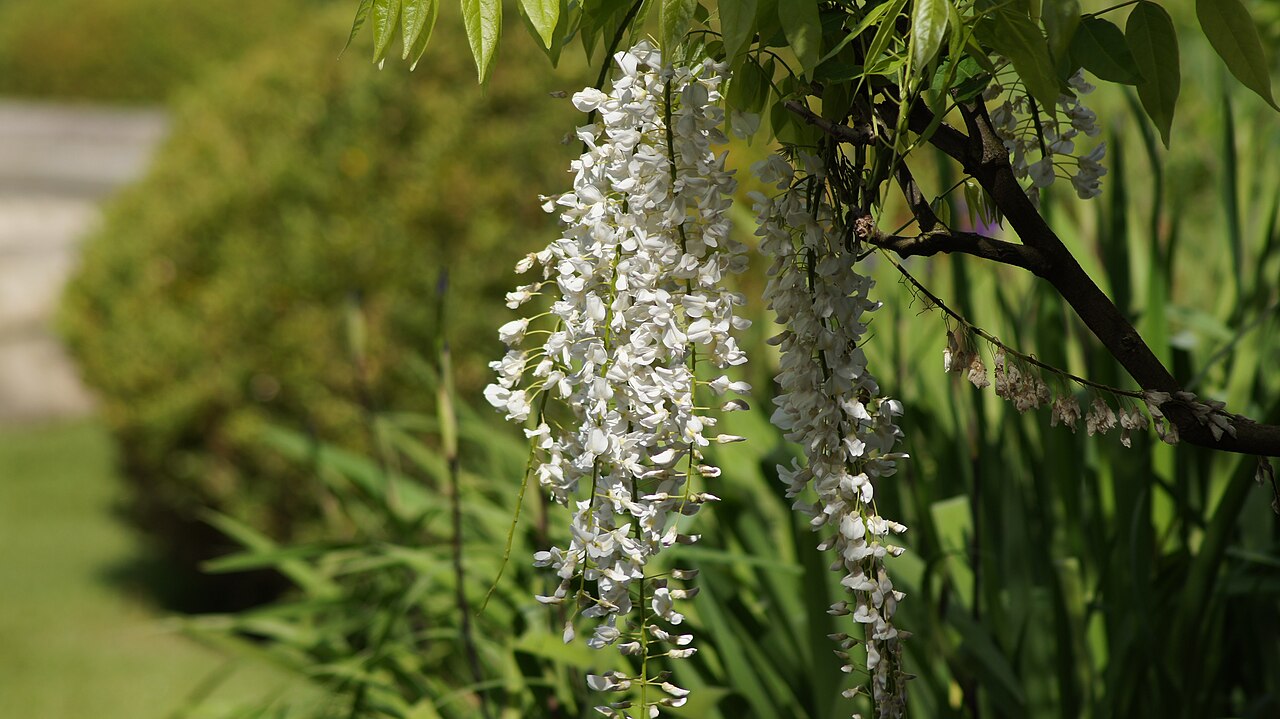
Featured photograph: white Japanese wisteria at St John’s Lodge, Regent’s Park, by ZeevoX, CC BY-SA 4.0. Image resized; no creative alterations.
GHUK content is written for UK growing conditions and informed by hands-on professional gardening experience. It is designed to be practical, clear and useful in real gardens.