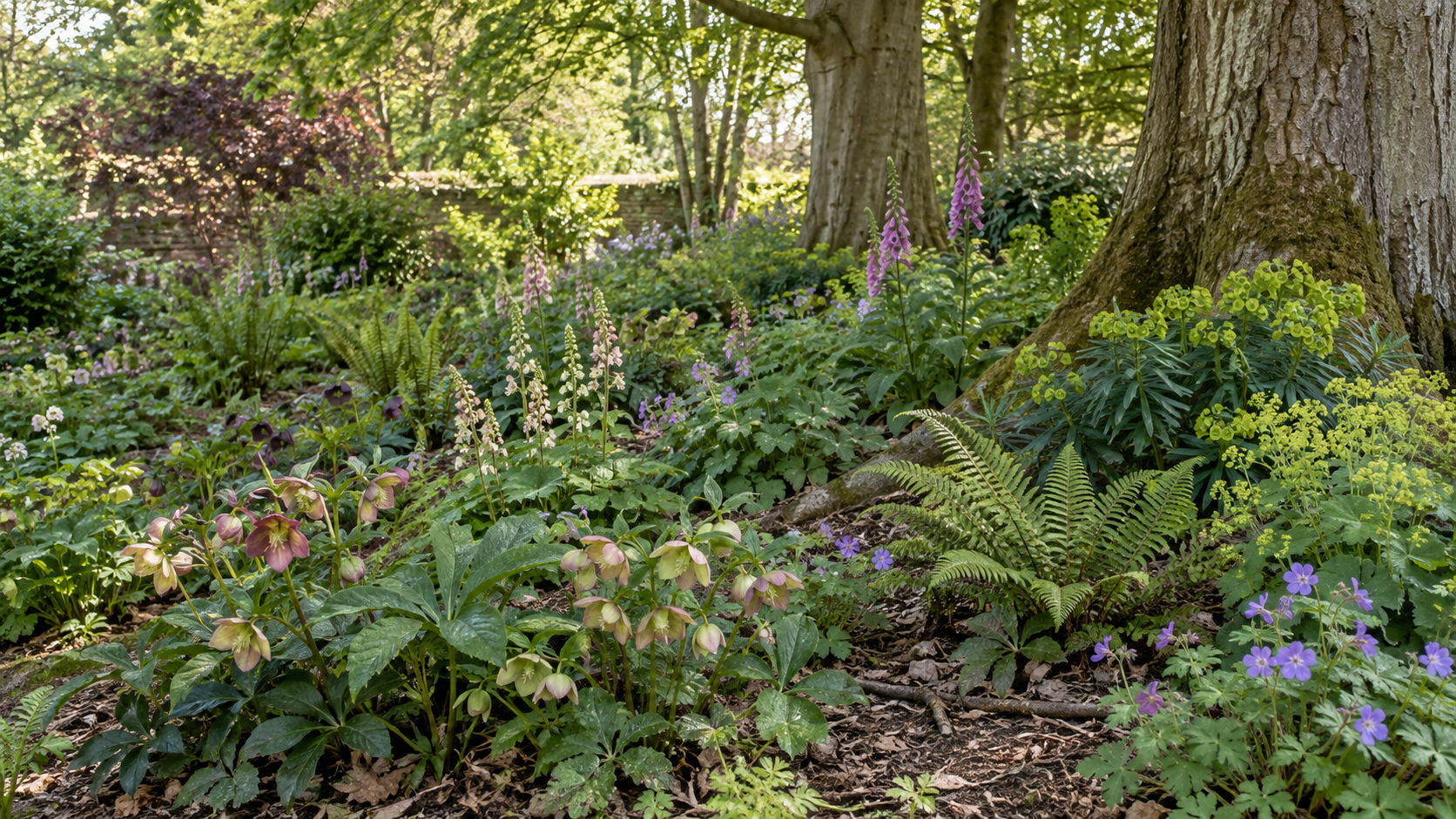
Dry shade is one of the hardest conditions in a garden. It is common beneath mature trees, along the base of hedges and beside walls that block both light and rainfall. Plants in these places face two problems at once: less sunlight and less available moisture.
That does not mean the ground has to remain bare. The key is to choose plants that can tolerate the conditions once established, then give them enough water and care to develop a strong root system. Even the toughest dry-shade plant will struggle if it is planted into dusty soil and forgotten.
The following eight plants are reliable places to start in UK gardens. Some cope with severe root competition better than others, so the notes below explain where each one is most likely to succeed.
What dry shade really means
Shade alone is not always the main difficulty. Under a large tree, an established network of roots takes up much of the available water. The canopy catches some rainfall before it reaches the ground, while evergreen trees and dense hedges can keep the area shaded throughout the year.
Walls create a different version of the same problem. The ground may sit in a rain shadow, especially beneath overhanging eaves, and receive very little direct moisture even when the rest of the garden is wet.
Conditions can vary within a few metres. The outer edge of a tree canopy may receive dappled light and occasional rain, while the soil close to the trunk can be extremely dry and crowded with roots. Start with the less severe areas and extend the planting only when you know which plants are coping.
Eight plants that can cope with dry shade
1 Epimedium
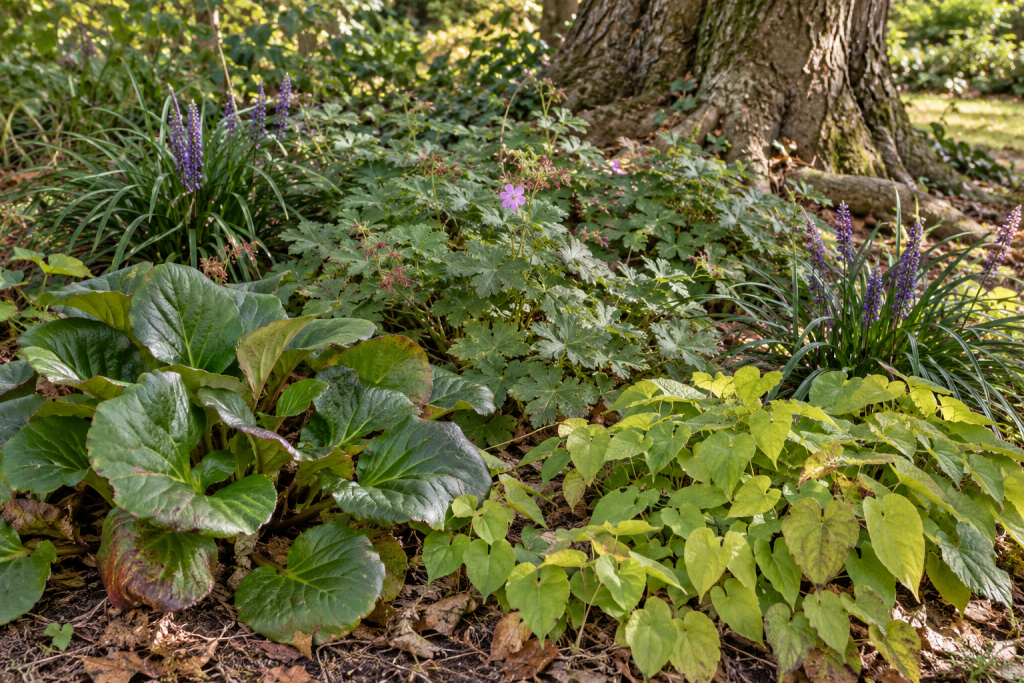
Epimediums combine useful ground-covering foliage with delicate spring flowers. Many form slowly spreading clumps, and the new leaves often emerge with bronze or red colouring before turning green.
Choose the plant carefully because not every epimedium tolerates the same level of dryness. Epimedium x versicolor ‘Sulphureum’ is a particularly dependable choice for dry shade beneath trees. Improve the immediate planting pocket with organic matter, keep it watered during establishment and allow it time to spread.
Best for: long-lived ground cover in dappled or fairly deep shade.
2 Bigroot geranium
Geranium macrorrhizum is one of the most dependable perennials for awkward shade. It forms a mat of aromatic, semi-evergreen foliage that suppresses weeds and carries pink or white flowers in late spring and early summer.
Once established, it copes well with dry soil and root competition. It is useful beneath deciduous trees, along hedge bottoms and in neglected corners where more demanding hardy geraniums fail. If the foliage looks tired after flowering, cutting it back can encourage fresh growth.
Best for: reliable, weed-suppressing ground cover.
3 Bergenia
Bergenias are tough evergreen perennials with large, leathery leaves. Many cultivars develop red or bronze tints in cold weather, giving useful structure when herbaceous plants have died back.
They tolerate shade and dry conditions once established, although flowering may be reduced in deep shade. Place them where the foliage can do most of the work visually, and where they receive at least a little indirect light. Early autumn is an excellent time to plant because the soil is usually cooler and moisture levels begin to rise.
Best for: bold evergreen leaves and winter structure.
4 Liriope
Liriope muscari, usually sold as lily turf, makes neat clumps of narrow evergreen leaves. Purple flower spikes appear from late summer into autumn, extending interest well beyond the main spring and summer display.
It is useful in dry shade, but flowers best where it receives some light for part of the day. In deeper shade it may still make good foliage but produce fewer flowers. Water newly planted clumps during dry spells in their first year.
Best for: tidy evergreen edging and late-season flowers.
5 Shield ferns
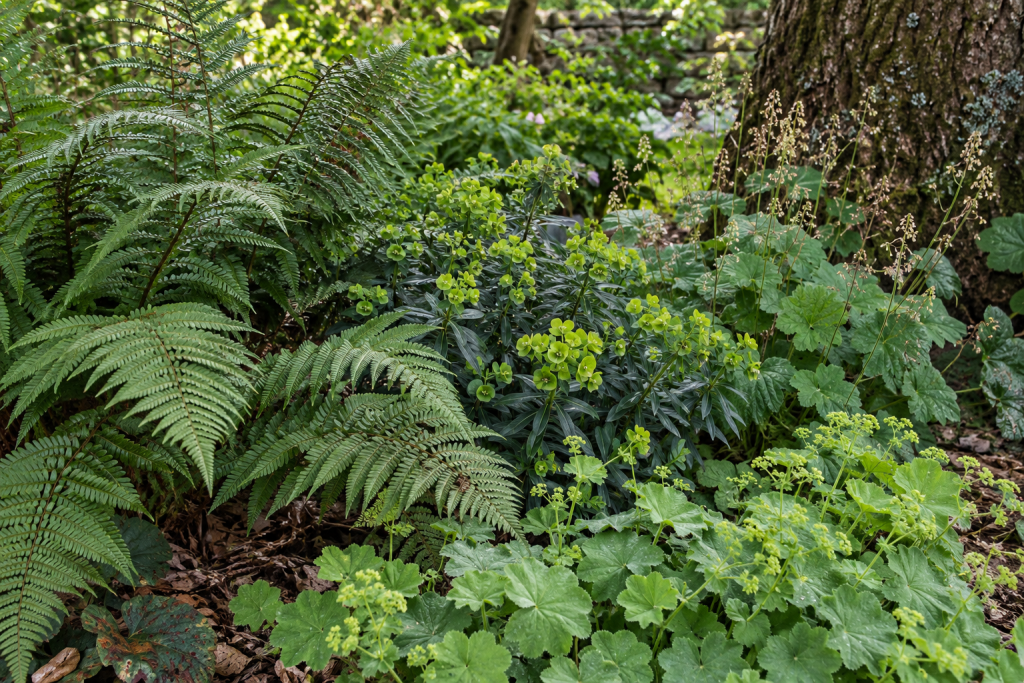
Shield ferns in the genus Polystichum bring shape and texture to a shady border. Their arching fronds contrast well with rounded leaves from plants such as bergenia and epimedium.
Most prefer moisture-retentive soil, but established plants can tolerate dry shade. Hard shield fern, Polystichum aculeatum, is a sound choice for a well-drained position. Plant in autumn or spring, water consistently while the crown settles and protect the fronds from strong, drying winds.
Best for: lasting structure and a woodland feel.
6 Tellima
Tellima grandiflora forms a low rosette of fresh green leaves, followed by slender stems of small, fringed flowers from late spring into summer. It suits informal and woodland-style planting and may seed itself into gaps when conditions are favourable.
Tellima prefers humus-rich soil that holds some moisture, but it will tolerate a drier position in shade. Use it in the outer part of a tree canopy or another spot that is dry rather than permanently parched. It is less suitable for the harshest ground immediately beside a thirsty trunk.
Best for: soft foliage and airy height in lighter dry shade.
7 Wood spurge
Euphorbia amygdaloides var. robbiae is an evergreen wood spurge that produces bright yellow-green bracts in spring. It spreads by underground rhizomes and can make a strong carpet where other plants struggle.
That spreading habit is both its strength and its main drawback. Give it room, watch the boundary of the clump and remove unwanted growth before it becomes difficult to control. Wear gloves when cutting or dividing euphorbias because the milky sap can irritate skin and eyes.
Best for: difficult dry shade where vigorous ground cover is useful.
8 Lady’s mantle
Alchemilla mollis has soft, scalloped leaves that hold droplets of water and sprays of lime-green flowers in early summer. It is adaptable, easy to divide and useful for softening the edge of a shady border.
It copes with partial shade and some dryness, but it does not enjoy extremely dry soil. Use it towards the brighter, less root-filled edge of the area rather than in the most severe spot. Cut it back after flowering if you want to prevent heavy self-seeding and encourage tidier new foliage.
Best for: edging and filling the less extreme parts of a dry-shade border.
How to plant successfully in dry shade
Choosing suitable plants is only half the job. Most failures happen during establishment, before the roots have spread beyond the original compost.
Plant in autumn when possible
Early to mid-autumn is usually the best time to plant beneath deciduous trees in the UK. The soil is still warm, rainfall is more dependable and the plants have time to develop roots before the tree canopy fills again in spring. Spring planting also works, but the plants may need more attention if dry weather arrives early.
Start with smaller plants
Small pots are often easier to fit between established tree roots than large specimens. They require smaller planting holes, disturb less soil and can adapt to the site as they grow. Place the pots on the ground first so you can find workable pockets without repeatedly digging around the same roots.
Soak the rootballs before planting
Dry compost can be difficult to re-wet once it is in the ground. Stand each pot in water until the rootball is thoroughly moist, allow it to drain and then plant it at the same depth at which it was growing in the container.
Improve the pocket without creating a pot
Loosen the soil carefully and mix a modest amount of well-rotted organic matter through the excavated soil. Avoid filling a small hole with rich compost alone, as this can encourage roots to remain inside the planting pocket. The aim is to improve water retention and soil structure while keeping the backfill similar to the surrounding ground.
Water deeply through the first growing season
Water thoroughly after planting and continue during dry spells for at least the first full growing season. A generous, less frequent soak is more useful than repeatedly wetting only the surface. Established tree roots will compete strongly for moisture, so check the soil rather than assuming rainfall has reached it.
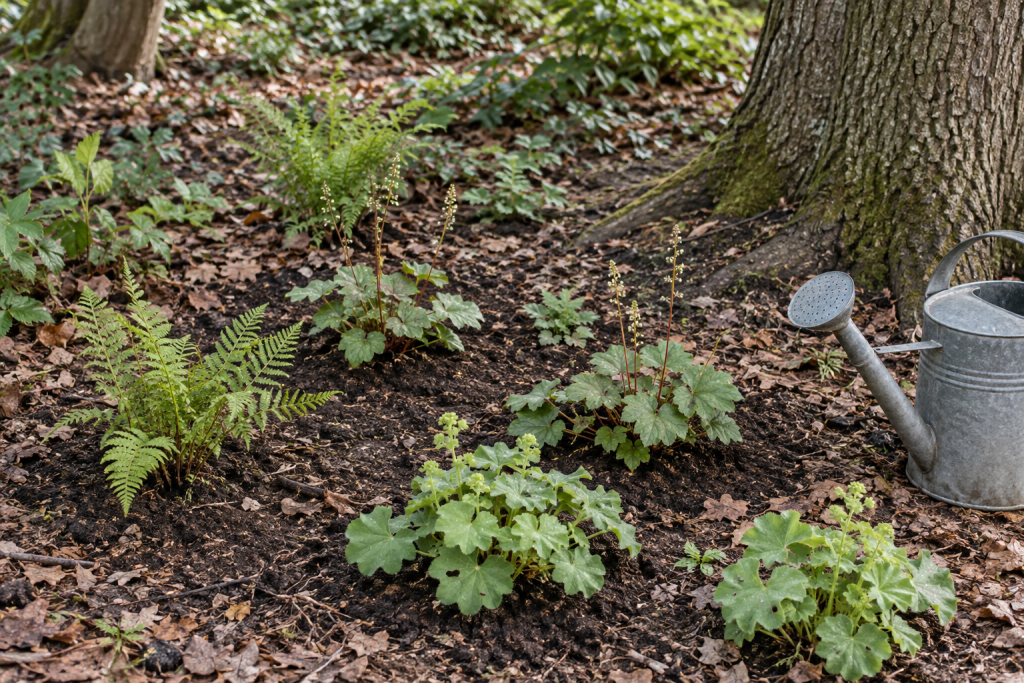
Mulch the soil surface
Apply a layer of garden compost, composted bark or leafmould after planting. This reduces surface evaporation, suppresses weeds and gradually improves the soil. Keep mulch clear of plant crowns and leave a gap around the tree trunk. Our guide to soil structure explains why regular additions of organic matter make difficult ground easier for roots to explore.
If you are buying composted bark or garden compost for a larger shady border, our mulch and compost calculator can help you estimate how much you need. Measure the area, choose your layer depth, and keep mulch away from tree trunks and plant crowns.
Planting beneath established trees safely
Tree roots take priority. Work with a hand trowel and plant into natural gaps rather than cutting through large roots to force a design into place. If a chosen position is packed with woody roots, move the plant and try another pocket.
Do not raise the soil level across the rooting area or pile compost and mulch against the trunk. Burying the root flare can trap moisture against the bark and harm the tree. A thin surface mulch is enough; repeated deep layers can change the soil level over time.
The area immediately beside the trunk is often the driest and most difficult place to establish new plants. Leaving a clear circle around the base usually looks more natural and reduces the risk of damaging important roots.
Common reasons dry-shade planting fails
Treating every shaded plant as suitable for dry soil. Hostas, astilbes and many woodland plants still need reliable moisture.
Planting in late spring or summer and allowing the rootball to dry out before roots reach the surrounding soil.
Choosing a plant for its flowers when the site is too dark for good flowering. Bergenia and liriope can remain attractive in leaf but bloom less in deep shade.
Using large plants that require wide holes among established roots.
Expecting instant coverage. Tough ground-cover plants still need time to knit together.
Ignoring vigorous spreaders. Wood spurge and self-seeding lady’s mantle need occasional control.
A practical way to begin
Begin with three or four species rather than buying one of everything. Use repeated groups of bigroot geranium, epimedium or bergenia to create the main ground cover, then add shield ferns or liriope for contrasting shape. Tellima and lady’s mantle can fill the brighter edges, while wood spurge is best reserved for a place where it has room to spread.
Plant a small test area first and watch it through a full summer. If the plants hold their foliage, make new growth and recover after dry spells, extend the same combination into the surrounding ground. Dry shade rarely changes overnight, but the right plants and careful establishment can turn a bare patch into one of the most characterful parts of the garden.
GHUK content is written for UK growing conditions and informed by hands-on professional gardening experience. It is designed to be practical, clear and useful in real gardens.